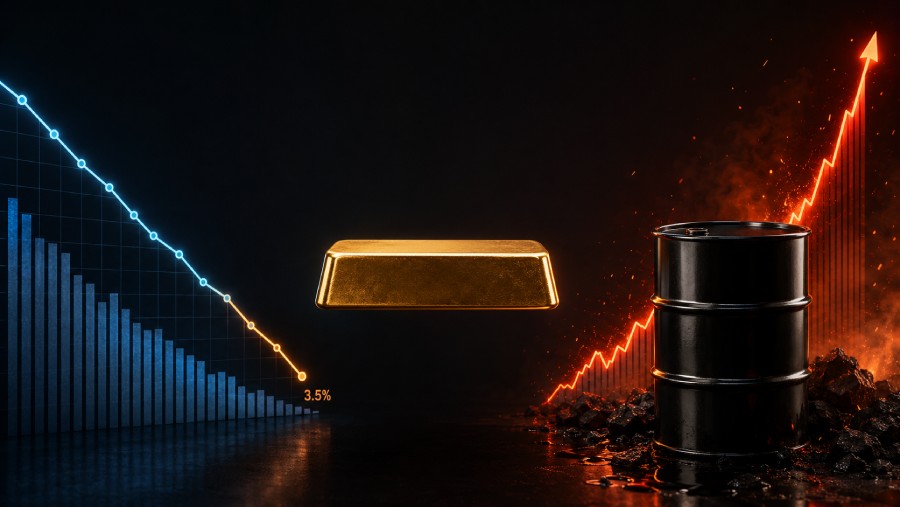
Something remarkable happened to US inflation this week, and it holds an important lesson for every gold buyer. On Tuesday, data showed that US consumer prices actually fell 0.4% in June — the first monthly decline since 2020 — and annual inflation slowed to 3.5% from 4.2%. Normally, cooling inflation is straightforwardly good for gold. Yet this Wednesday July 15, gold is not soaring; it is hovering near $4,040, having given back part of Tuesday’s gains. Understanding why reveals how finely balanced today’s market really is.
First, why cooling inflation helps gold. When inflation falls, the Federal Reserve faces less pressure to raise interest rates. Since gold pays no interest and competes with interest-bearing assets like bonds and savings accounts, lower rates make gold relatively more attractive. So when June’s inflation came in at 3.5% — below the 3.8% forecast, with the first monthly price decline in six years — traders scaled back their expectations for Fed rate hikes, and gold jumped more than 1% on Tuesday. Today’s producer price data reinforced the trend: wholesale prices unexpectedly fell in June for the first time in nearly a year. On its own, this cooling inflation is a clear positive for gold.
So why didn’t gold simply soar and keep climbing? Because a powerful counterforce is pulling in the opposite direction: the war. Even as inflation data for June looked encouraging, the US-Iran conflict has escalated sharply in July. US airstrikes have hit Iranian military sites for four straight days, the US has reinstated its naval blockade, and Iran continues to declare the Strait of Hormuz closed. This has pushed oil prices up more than 9% in five days. And here is the key: June’s good inflation number reflects last month’s lower oil prices, but July’s oil surge threatens to push inflation right back up. The market knows this. So even with cooling inflation, traders remain cautious, keeping the odds of a September rate hike near 50%.
There is also the Fed’s own messaging. Chair Kevin Warsh, testifying before Congress on Tuesday, welcomed progress on inflation but firmly reaffirmed that the central bank has “no tolerance” for persistently elevated inflation. He deliberately avoided signaling that rate cuts are coming. This careful, balanced stance keeps gold from breaking decisively higher.
For Gulf jewellery buyers, the takeaway is this: gold is being held in a tight range by two opposing forces of nearly equal strength. Cooling inflation supports it; the war-driven oil surge caps it. Gold near $4,040 is roughly 27% below January’s record of $5,597 and still up 21.3% over the past year. The structural demand remains strong — China’s central bank bought gold in June at its fastest pace in over two and a half years. When one of these two forces eventually wins out — either inflation keeps cooling or the war resolves — gold could move sharply. For now, it waits in balance.