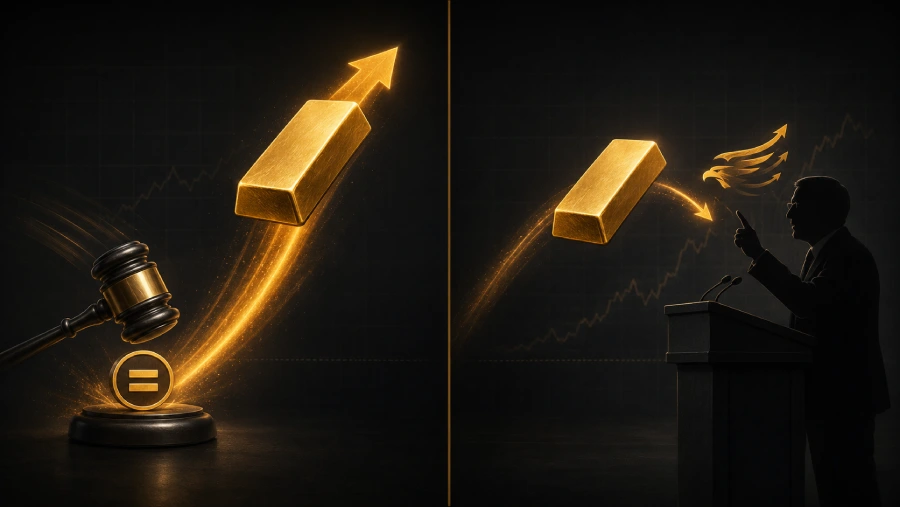
This week delivered one of the most instructive sequences of the year for gold buyers. On Wednesday, the Federal Reserve held interest rates steady, and gold jumped 2%. Then, as Chair Kevin Warsh spoke, the rally faded. By this Friday July 31, gold has eased back toward $4,060 — yet it is still set for its first monthly gain in five months. Understanding this back-and-forth teaches something valuable about what really drives gold.
Start with why gold jumped when the Fed held rates. Leading into Wednesday’s decision, markets had priced in a meaningful chance — around 81% for September — that the Fed would soon raise rates. When the Fed instead held steady and the decision landed, the US dollar and Treasury yields fell. Because gold pays no interest, it competes with the dollar and with yield-bearing bonds; when both weaken, gold becomes more attractive, and it rallied 2%, reaching its highest level since July 23.
Then came the twist. Fed Chair Kevin Warsh held his press conference, and his tone was firmly hawkish. He reaffirmed the Fed’s commitment to bringing inflation down to 2%, and stated the central bank has “no higher soft target” for inflation. Three committee members had even dissented, wanting an immediate rate hike. As markets absorbed this hawkish message — that the Fed remains determined to fight inflation and could still hike in September — some of gold’s rally faded. The initial relief at the rate hold gave way to the sobering reality of a Fed still leaning hawkish. This is why gold gave back part of its gains.
Thursday and Friday added more crosscurrents. On the supportive side, inflation cooled: the Fed’s preferred gauge, core PCE, rose just 0.1% in June, and headline PCE fell for the first time since April 2020. Economic growth slowed to 1.5%. And the dollar weakened further, partly on suspected Japanese intervention to support the yen. On the pressuring side, the war reignited — the US launched fresh strikes on Iran, keeping energy-driven inflation risk alive — and Warsh’s hawkish stance kept September hike bets around 60%.
Here is the lesson for gold buyers. Gold’s price is driven above all by the interplay between inflation and interest rate expectations. When rates are held or expected to fall, gold rises; when the Fed signals hawkishness, gold faces pressure. This week showed both forces in rapid succession — a rate hold lifting gold, then a hawkish tone tempering it. The net result, though, is telling: despite the hawkish Fed and the reignited war, gold is finishing July higher, its first monthly gain since February.
For Gulf jewellery buyers, the takeaway is encouraging. Gold near $4,060 is about 27% below January’s record of $5,597 and up roughly 21.5% over the past year. The fact that it rose on the month despite every headwind reflects its underlying strength — supported by relentless central bank buying, with a net 41 tonnes purchased in May and 89% of reserve managers expecting global holdings to keep rising. Watch next Friday’s July jobs report, which could shape the September rate decision and gold’s next move.