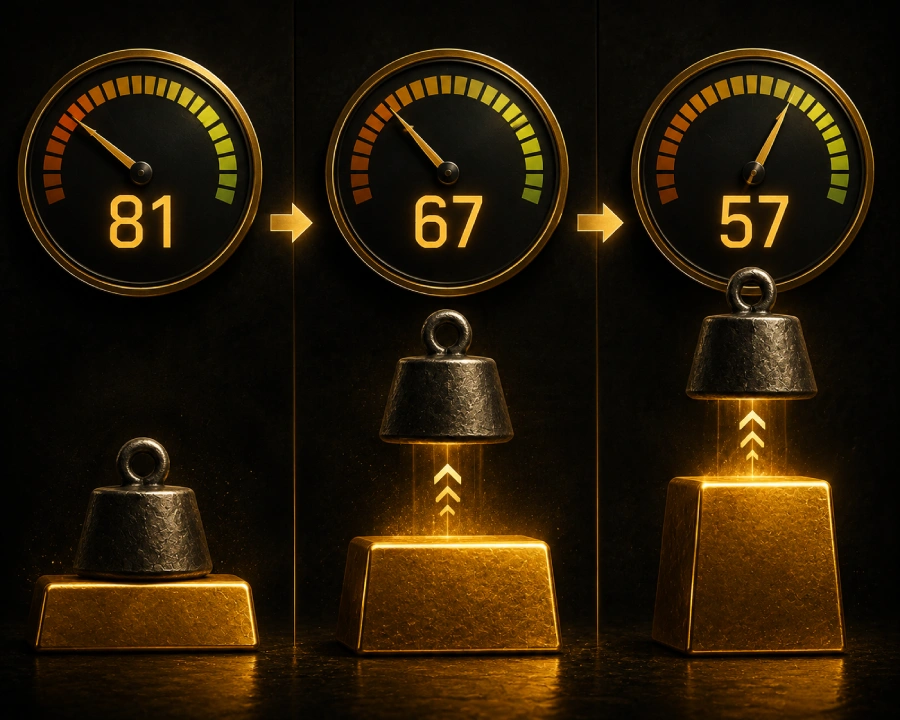
While the headlines this Wednesday August 5 blare with ultimatums and deadline drama, the force doing the most steady work lifting gold — now up three days running to two-week highs near $4,130 — is something quieter: the probability of a September Federal Reserve rate hike has collapsed from roughly 81% to 57% in barely a week. Understanding what these percentages are, why they are falling, and why gold rises as they fall is one of the most useful lessons in modern gold markets. Here is a clear guide.
First, what do these numbers mean? Financial markets contain instruments tied directly to future Federal Reserve interest rate decisions. By watching how traders price those instruments, analysts can calculate the implied probability the market assigns to a rate hike at any upcoming meeting — a live, constantly updating vote on what thousands of professional investors collectively expect. Before last week’s Fed meeting, that vote stood near 81% for a September hike. After the Fed held rates, it fell to the mid-60s. A day ago it was 67%. Today it is roughly 57%. In one week, a September hike has gone from near-certain to barely better than a coin flip.
Why is this happening? Three reasons are converging. First, inflation is genuinely cooling: the Fed’s preferred gauge rose just 0.1% in June, and one headline measure fell for the first time since April 2020. Second, the economy is slowing, with second-quarter growth at just 1.5%, well below forecasts. Third — and most powerfully this week — the prospect of a reopened Strait of Hormuz promises to send oil prices sharply lower. President Trump himself predicted oil would “drop through the floor” when the conflict ends. Since war-driven oil inflation was the main argument for hiking, every step toward a Hormuz deal weakens the case for higher rates.
Now the crucial link to gold. Gold pays no interest, so it competes with assets that do. When rates are expected to rise, bonds and savings become more attractive and gold suffers — this is precisely the mechanism that suppressed gold all year. When hike expectations fall, that competitive pressure eases, and gold recovers. The collapse from 81% to 57% is, in effect, a large weight being progressively lifted off gold’s back. This is why the metal has climbed three straight days even before any deal is signed.
There is a supporting cast worth noting too. Gold-backed exchange-traded funds in China continue attracting inflows, with institutional investors defending the $4,000 level whenever it is approached — a sign that sophisticated money is positioning for exactly this dovish turn. And Friday’s July jobs report could accelerate everything: a weak reading would cut the hike odds further and lift gold; a strong one would revive them.
A caution for balance: the deadline drama is real. Trump has threatened “decapitation” and massive strikes if talks fail, while Iran denies negotiating with Washington at all. A collapse into war would whipsaw oil upward and revive the inflation-and-hikes story. But even then, gold’s safe-haven demand would engage — which is why the metal is rising into this binary moment rather than retreating from it.
For Gulf jewellery buyers, gold near $4,130 is about 26% below January’s record and up roughly 21.6% over the past year, supported by central banks that bought 244 tonnes in the first quarter alone. The quiet number to watch is not the ultimatum clock — it is that hike probability. Every point it falls is a tailwind for gold.