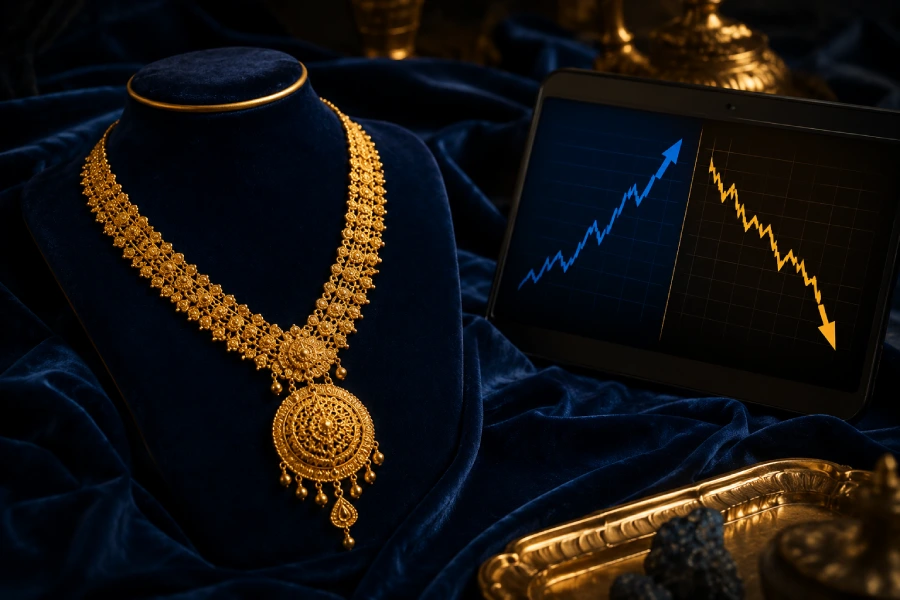
The Strait of Hormuz has been declared closed. The United States has struck 140 Iranian targets. Iran has hit US bases across the Gulf. Qatar has suspended all maritime activity. And gold — the asset the world turns to in times of crisis — has fallen more than 2% to around $4,020 per ounce this Monday July 13. If this seems backwards, you are not alone. Understanding why war is pushing gold down rather than up is the single most important thing any gold buyer can learn in 2026.
The traditional rule is simple: in times of war and crisis, investors buy gold as a safe haven, and the price rises. This rule has held for centuries. But in 2026, a different and more powerful force has taken over — and that force is the Federal Reserve.
Here is the chain. The Strait of Hormuz carries roughly a fifth of the world’s oil. When Iran closes it — as it formally did this weekend after the Revolutionary Guard struck a container ship — oil supply is threatened and oil prices surge. Brent crude jumped 7.1% to $81.40 a barrel this week, with US crude up 7.2% to $76.50, both at their highest since mid-June. Higher oil prices feed directly into inflation, because energy costs flow through the entire economy — into transport, manufacturing, food, and gasoline at the pump.
Now the crucial link. When inflation rises, the US Federal Reserve must respond by keeping interest rates high, or raising them further, to bring inflation back under control. And this is where gold suffers. Gold pays no interest — it earns nothing simply by being held. When interest rates rise, savings accounts and government bonds become more attractive by comparison, and money flows out of gold. Following this weekend’s escalation, markets have raised the probability of a September Fed rate hike to nearly 70%. The dollar strengthens on that expectation, which makes gold more expensive globally and pushes the price down further.
So the war, rather than lifting gold as a safe haven, is pushing it down through the inflation-and-interest-rate channel. This is the defining paradox of the 2026 market.
For Gulf jewellery buyers, the practical implication is important. Gold near $4,020 is now roughly 28% below its January record of $5,597 — the deepest discount of the year. The forces driving it down are monetary and, by their nature, cyclical: interest rate cycles always turn. Meanwhile the structural forces supporting gold remain firmly in place. China’s central bank reported its largest monthly increase in gold reserves in more than two and a half years in June, and central banks worldwide continue to accumulate. Gold is still up 19.5% over the past year despite everything. This week, Fed Chair Warsh testifies before Congress on Tuesday and the June CPI report arrives — both will shape what happens next.