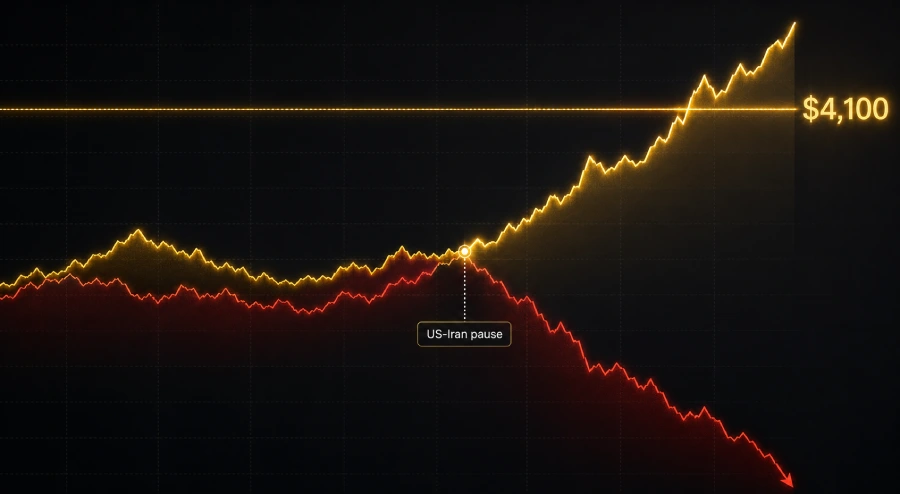
This Wednesday July 29 should, by any traditional logic, have been a wild day for gold. Overnight, Iran fired ballistic missiles at US forces, reigniting a war that had been paused for days. This afternoon, the Federal Reserve decides on interest rates. Either event alone might be expected to send gold lurching. Yet gold has barely moved, holding steady just under $4,100. Understanding why reveals one of the most important dynamics in today’s gold market: the forces acting on the metal have reached a remarkable balance.
Consider first the war news. Iran’s Revolutionary Guard launched what US officials called an attempted surprise attack, firing multiple ballistic missiles at American troops in the region; US forces shot them all down. This ended a days-long pause in the fighting and sent oil prices jumping — West Texas crude rose 4.7% to around $83 a barrel. In an ordinary conflict, this kind of escalation would send gold soaring as investors sought safety.
But 2026 is no ordinary market, and here is the balance. The war pushes gold in two opposite directions at once. On one side, renewed fighting drives up oil, which raises inflation, which pushes the Federal Reserve toward higher interest rates — and because gold pays no interest, higher rates pull its price down. On the other side, war and uncertainty draw some investors toward gold as a safe haven, pushing its price up. These two forces have been almost perfectly offsetting each other. That is why gold has held above $4,000 for two full weeks, even as the war swung from escalation to pause and back to escalation.
Now add the second force of the day: the Federal Reserve. The Fed announces its rate decision at 2:00 PM ET, with Chair Kevin Warsh speaking at 2:30 PM. Markets widely expect the Fed to hold rates steady, so the decision itself is largely priced in and may not move gold much. The real question is Warsh’s tone. If he sounds worried about inflation and signals more hikes ahead, gold could fall. If he sounds patient, gold could rise. This uncertainty is another reason traders have held gold steady — they are waiting to hear Warsh before committing.
There is a deeper support underneath all of this, and it explains why gold keeps finding buyers near $4,000. Every time the price dips toward that level, investors step in to buy — what market watchers call dip-buying. Behind that steady demand are the world’s central banks, which bought a net 41 tonnes of gold in May and 244 tonnes in the first quarter. A World Gold Council survey found that 89% of reserve managers expect global central bank gold holdings to keep rising. This persistent institutional demand is the floor that keeps gold anchored above $4,000.
For Gulf jewellery buyers, the takeaway is reassuring. Gold near $4,050 is about 28% below January’s record of $5,597 and up roughly 19% over the past year. Its steadiness reflects genuine balance, not weakness. Watch two things next: Warsh’s tone this afternoon, and tomorrow morning’s PCE inflation data — the Fed’s preferred gauge — which could move gold as much as today’s decision.